
The Hidden Audit Risk in Manual Maintenance Records

27 Jul, 2026 · min read
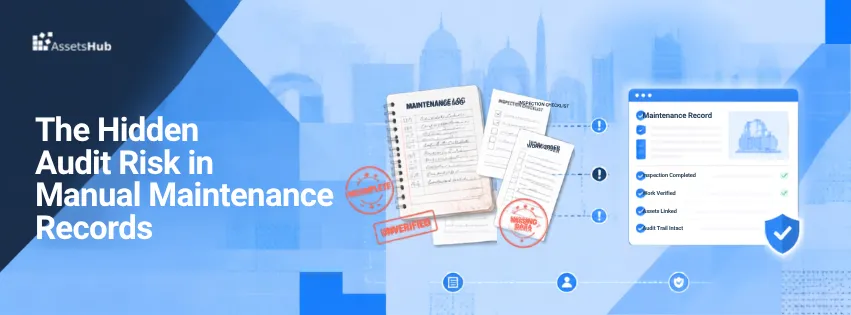
A regulator or insurer requests a complete maintenance history for a specific piece of equipment, following an incident or a routine audit. The maintenance team knows the equipment has been serviced regularly, they can point to the technicians who did the work, describe the general schedule, even recall specific repairs. But producing an actual, verifiable, chronological record, dates, who performed the work, what was found, what was done, for that specific asset turns into a multi-day search through paper folders, old emails, and someone's memory. The knowledge that the work was done exists. The auditable record of it doesn't, or exists in a form that can't be produced quickly or credibly enough.
Where This Shows Up
This shows up in any maintenance operation subject to regulatory oversight, insurance requirements, or contractual service obligations, which covers most asset-heavy industries, from fuel stations and industrial facilities to healthcare and food service equipment. Organizations often treat audit readiness as a compliance department's concern rather than a maintenance operations concern, but the actual evidence an audit needs lives entirely within maintenance records. A gap here isn't abstract legal risk, it's a very concrete moment where someone has to prove something happened, using records that were never built with that moment in mind.
What an Auditable Maintenance Record Actually Requires
An auditable maintenance record is a chronological, attributable, and verifiable account of what maintenance work was performed on a specific asset, by whom, when, and what was found or changed. Attributable means the record can be tied to a specific person who performed the work, not just a general team. Verifiable means the record's timing and content can reasonably be trusted as accurate, typically because it was created at or near the time the work happened, rather than reconstructed afterward. A folder of paper work orders or a spreadsheet log can technically contain this information, but whether it functions as a true audit trail depends on how reliably that information can be retrieved, verified, and trusted under scrutiny, not just whether it exists somewhere. This sits within the broader shift toward digital transformation in maintenance operations, where audit readiness is one of the concrete, high-stakes outcomes at issue.
Five Structural Components of Audit Risk
Retrieval time vs. retrieval possibility. Records that technically exist but take days to locate and compile fail an audit's practical timeline even if the information itself is accurate.
Attribution gaps. Records that show "serviced" without a specific technician, date, or method don't hold up as evidence the way a signed, timestamped entry does.
Retroactive reconstruction risk. Records filled in after the fact, from memory or informal notes, carry less evidentiary weight than records created contemporaneously with the work, a distinction that matters specifically under scrutiny.
Fragmentation across formats. Paper in a filing cabinet, notes in a supervisor's phone, entries in different spreadsheets per site, no single retrieval path exists, and the completeness of any answer depends on whoever happens to be asked.
Multi-market regulatory variance. For organizations operating across several countries in a region, documentation and retention requirements often differ by market, which paper-based systems have no structural way to track or enforce differently per site.
What Happens When an Audit Request Arrives
A request arrives, from a regulator, insurer, or client, for a complete maintenance history on a specific asset, often with a short, defined deadline.
Someone has to first determine which physical location or system might hold the relevant records, which isn't always obvious if the asset has changed hands, sites, or maintenance teams over its lifetime.
Paper folders, emails, and any spreadsheet logs are manually searched, often by someone who wasn't involved in the original work and has to interpret abbreviations or informal notes left by others.
Gaps are filled, where possible, by asking whichever technician or supervisor might remember the specific work, a source that's inherently less reliable than a contemporaneous record, and not always available if that person has since left the organization.
The final record produced is a reconstruction, assembled under time pressure, rather than a document that existed in complete form before the request came in.
If the reconstruction has gaps that can't be filled, that becomes the actual finding of the audit, not necessarily because the maintenance wasn't done, but because it can't be proven that it was.
What This Actually Means
An organization can have excellent actual maintenance practices and still fail an audit, because the audit isn't testing whether the work happened, it's testing whether the work can be proven to have happened, on demand, in a form that holds up to scrutiny. This is a distinction many operations teams don't fully internalize until the first time it costs them something: a failed audit finding, a denied insurance claim, or a client walking away from a service contract, all because of documentation gaps rather than actual maintenance failures.
Business Impact
Financial. Audit findings can trigger fines, remediation costs, or lost contracts, independent of whether the underlying maintenance was actually adequate; insurance claims can be reduced or denied without a verifiable maintenance trail supporting the claim.
Operational. The reconstruction effort during an actual audit pulls staff time away from ongoing maintenance work, often under time pressure.
Reliability. Without accessible historical records, patterns in recurring asset failures are harder to spot and address, the same data that supports an audit trail is also what would otherwise drive better preventive maintenance decisions.
Compliance. This is the most direct impact, an organization operating across multiple markets in a region may need to satisfy different regulatory bodies with different documentation standards, and a paper-based system has no structural way to track or enforce those differences per site.
Safety. In a post-incident investigation specifically, an incomplete maintenance record can shift the burden of proof onto the organization in exactly the moment when a strong, verifiable record would matter most.
A Representative Example
The following is an illustrative, representative scenario, not a specific customer case.
A fuel station network operating across several countries in the region maintained equipment records on a mix of paper logs and site-level spreadsheets, with each country's operations team handling documentation according to its own informal conventions. When one market's regulatory body requested a complete maintenance history for underground storage tank inspections across all stations in that country, ahead of a routine compliance review, the request had a three-week deadline.
The company discovered that inspection records existed for most stations, but in inconsistent formats, some as scanned paper forms, some as entries in a shared spreadsheet, a few only as notes referenced in email threads between a site manager and a contracted inspector. Two stations had records that couldn't be located within the review period, despite maintenance staff being confident the inspections had actually taken place. The regulator's finding cited incomplete documentation at those two stations as a compliance gap, regardless of whether the underlying inspections had occurred, because the standard being assessed was whether the record could be produced and verified, not just whether the work had likely been done.
The company's operations in another country, which had separately begun digitizing inspection records the previous year specifically because of a different regulatory requirement in that market, were able to produce the equivalent history within a day.
Common Challenges and How to Overcome Them
Records exist but retrieval takes too long for a real audit deadline. Don't just keep records, organize them so a specific asset's complete history can be retrieved in minutes, not days, well before any audit request arrives.
Attribution gaps. Require every maintenance entry to capture who performed the work, when, and what was found, as a non-negotiable minimum, not an optional field.
Records reconstructed after the fact carry less evidentiary weight. Build habits and systems that make contemporaneous logging, at the time of the work, the default, not something added later from memory.
Documentation fragmented across formats and locations. Consolidate to a single retrieval path per asset, even if full digitization isn't immediate, at minimum, know exactly where every asset's complete record lives.
Different regulatory requirements per market with no way to track compliance differences. Map documentation and retention requirements by market explicitly, and build retention and format rules into the maintenance process per site rather than relying on informal awareness.
Where System Design Closes the Gap
Audit readiness isn't primarily a documentation policy problem, it's a retrieval and attribution problem, which is exactly what a structured system is built to solve. A system that captures who did what work, when, and what was found, as a mandatory part of closing a work order, produces an audit trail as a byproduct of normal operations rather than a special project undertaken only when an audit request arrives.
AssetsHub records a timestamped, attributable history for every asset automatically as work orders are logged and closed, with photos and notes attached at the time the work happens rather than added later. A complete maintenance history for any specific asset can be pulled directly from the system, rather than reconstructed from scattered paper and spreadsheet sources.
Building Audit-Ready Records Into Everyday Work
Building audit-ready records into everyday maintenance work typically follows this sequence in AssetsHub:
Every work order requires the technician who performed the work to be identified, along with a timestamp captured automatically at the time of logging, not entered manually after the fact.
Checklists and required fields for regulated maintenance tasks, such as safety inspections or equipment-specific compliance requirements, are built into the work order template, so the record required for audit purposes is generated as part of doing the work, not as a separate step.
Photos and notes are attached directly to the work order at the time of the visit, providing verifiable evidence beyond a written description alone.
A complete history for any asset, every work order, inspection, and repair, attributed and timestamped, is retrievable directly from the asset's record at any time, without a separate reconstruction effort.
Where documentation requirements differ by market, retention rules and required fields can be configured per site, so compliance requirements specific to each country are enforced structurally rather than depending on local staff remembering them.
FAQ
How far back should our maintenance records typically be retrievable?
This depends on your specific regulatory and insurance requirements, which vary by market and asset type, so there's no single universal answer. The more important question to ask internally is whether you actually know your specific retention requirements per market, many organizations discover they don't, only when an audit forces the question.
Does having paper records at all satisfy an audit, even if they're disorganized?
Not necessarily. Most audits assess whether a complete, verifiable record can be produced within a defined timeframe, not just whether documentation exists somewhere in the organization. Disorganized records that can't be retrieved and verified quickly enough often get treated the same as missing records, regardless of whether the underlying work was actually done.
What's the difference between a maintenance log and an audit trail?
A maintenance log can be informal, notes, reminders, a general record of activity. An audit trail specifically needs to be attributable to a person, timestamped at or near the time of the work, and retrievable on demand. A log can exist without meeting those requirements, which is exactly the gap that causes audit findings even when maintenance work itself was genuinely happening.
How much does it matter if records were entered a few days after the work, rather than immediately?
A short, reasonable delay is generally acceptable and common in most operations. The concern is delay significant enough that the record starts relying on memory rather than fresh observation, or delay that becomes routine rather than occasional, both weaken the record's reliability as evidence, even if the eventual content is accurate.
Should audit readiness be the maintenance team's responsibility or the compliance team's?
Both, but the underlying data has to come from maintenance operations regardless of who owns the audit relationship. A compliance team can define what's required, but if maintenance records aren't captured in a retrievable, attributable way at the point of work, no amount of compliance oversight afterward can produce a record that was never properly created.
Conclusion
The gap between doing maintenance work and being able to prove it was done is where most audit findings actually come from, not from maintenance failures, but from documentation that can't be retrieved, attributed, or verified quickly enough when someone asks. An organization can have genuinely solid maintenance practices and still fail an audit for reasons that have nothing to do with whether the equipment was actually cared for.
The practical takeaway is to treat audit readiness as a property of how records are captured every day, not a project undertaken when a request arrives. Attribution, timestamps, and reliable retrieval built into routine maintenance work turn an audit trail into a byproduct of normal operations, rather than a reconstruction exercise under deadline pressure.