
Why Spreadsheets Break Down Across Multiple Sites

27 Jul, 2026 · min read
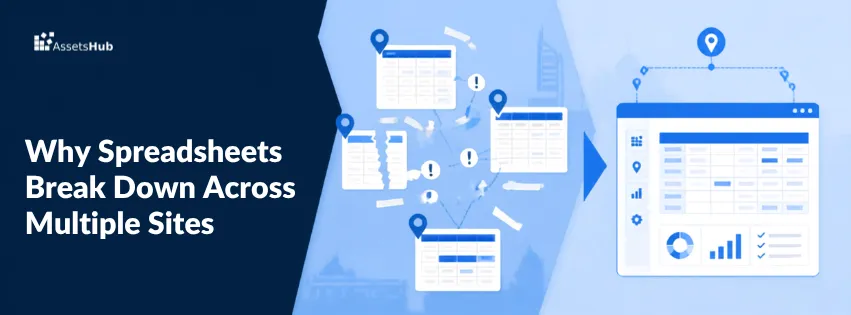
A single-site spreadsheet works fine. One person manages it, knows its quirks, updates it daily. The company opens a second site, then a third, and each new location gets its own spreadsheet, because that's what worked before. At five sites, no one can answer a simple question, which locations have overdue preventive maintenance this week, without manually opening five separate files and cross-referencing them by hand. The system didn't fail all at once. It worked fine at each individual site while quietly stopping being a system at the organizational level.
Where This Shows Up
This pattern appears in any organization that scales from one site to several, retail chains, facilities management companies, fuel station networks, hospitality groups, logistics operators, without ever redesigning how maintenance data is captured and aggregated. Spreadsheets get chosen for a single site because they're flexible and require no setup. That same flexibility becomes the problem at scale, because nothing enforces a consistent structure across files created independently at different times, by different people, often with different conventions.
What Spreadsheet Fragmentation Actually Means
Spreadsheet fragmentation is what happens when each site, team, or facility maintains its own independent maintenance spreadsheet rather than a shared structured system. Individually, each spreadsheet can work well enough for its own site. Collectively, they can't answer any question that spans more than one location, because there's no guarantee the files share the same categories, naming conventions, or even the same layout, and no automatic way to combine them. This is distinct from a single messy spreadsheet at one site, which is a data-quality problem. Fragmentation is a structural problem that specifically emerges once an organization crosses from one location to several, and it connects directly to the broader challenge of digital transformation in maintenance operations.
Four Structural Components of Fragmentation
No shared schema. Each site's spreadsheet may use different column names, categories, or units for the same underlying data, making automated aggregation impossible without manual cleanup.
No single source of truth for cross-site questions. Any organization-wide report, overdue PM by site, total spend, technician workload, requires manually collecting and reconciling files, usually by one overworked person.
Version and access chaos. Multiple people editing copies of the same file, emailed back and forth or stored in inconsistent folders, means no one is fully certain which version is current.
Nonlinear growth of the problem. Going from one site to two doubles the reconciliation effort. Going from five to fifteen doesn't just triple it, since the manual cross-referencing burden grows faster than the site count itself.
How Fragmentation Typically Develops
Site one launches with a spreadsheet built by whoever happened to set it up, using whatever categories made sense to them at the time.
Site two opens, and rather than adopting a shared structure, someone, often local staff, builds a new spreadsheet from scratch or copies the first one and modifies it.
By site three or four, the spreadsheets have diverged enough, different column orders, different terminology for the same asset categories, different levels of detail, that combining them requires manual reinterpretation, not just copy-paste.
Someone at headquarters is eventually tasked with producing an organization-wide report, and spends days reconciling files that were never designed to be combined.
That reconciliation work has to be repeated every reporting cycle, since the underlying spreadsheets remain fragmented, nothing about the process actually got fixed, only patched temporarily.
What This Actually Signals
The failure isn't that any individual site's spreadsheet is bad, most of them work fine locally. The failure is structural, and it specifically doesn't show up until someone tries to ask a question that spans more than one site. Organizations that judge their maintenance tracking site-by-site can look completely fine while being unable to answer basic organization-wide questions, which is exactly the blind spot that matters most for multi-site decision-making, budget allocation, staffing, or comparing site performance.
Business Impact
Financial. Reconciliation labor cost repeats every reporting cycle, and parts or inventory decisions get made without visibility into what other sites already have on hand.
Operational. Comparing site performance, allocating technician resources, or benchmarking best practices across sites becomes guesswork rather than data-driven, since no consistent cross-site dataset exists.
Reliability. Preventive maintenance compliance can't be monitored at the organization level, only site by site if someone happens to check each file individually, meaning systemic issues across sites go unnoticed until they show up as a pattern of failures.
Compliance. Producing a consolidated compliance report across multiple sites, especially where regulatory requirements differ by market, becomes a manual reconstruction project rather than a standard report.
Safety. Safety-critical patterns that would be obvious across sites, a specific asset type failing repeatedly at multiple locations, stay invisible when each site's data lives in isolation.
A Representative Example
The following is an illustrative, representative scenario, not a specific customer case.
A facilities management company expanded from a single site in one market to nine sites across the Gulf and Levant over roughly three years, adding one or two new locations at a time. Each new site's maintenance team built its own spreadsheet, generally copying whatever the most recently opened site had used, with local adjustments for the specific building types and equipment on hand.
When the company's operations lead was asked to prepare a regional maintenance performance summary for leadership, the task took the better part of three weeks. Column headers for the same category of work varied across files, some sites tracked "HVAC" as one category, others split it into "cooling" and "heating" separately. Date formats differed. Two sites had stopped updating their spreadsheets consistently months earlier without anyone at headquarters noticing, since there was no automatic way to flag a stale file. The final report required manually opening all nine spreadsheets, re-categorizing entries by hand to align them, and following up individually with two site managers to fill in missing months.
The underlying problem wasn't any single site's data quality, most sites tracked their own maintenance reasonably well in isolation. It was that nothing about the process was designed to work across nine sites at once, and every reporting cycle required rebuilding that structure manually from scratch.
Common Challenges and How to Overcome Them
Each new site builds its own spreadsheet independently. Define and enforce a single shared template and schema before opening a new site, not after the fact.
No way to detect a stale or abandoned file. Establish a recurring check-in cadence for spreadsheet-based sites specifically, since there's no automatic flag for inactivity the way a live system would provide.
Reconciliation work repeats every reporting cycle with no lasting fix. Treat any manual reconciliation project as a signal to invest in a shared structure once, rather than repeating the same one-off cleanup indefinitely.
Version and access confusion across emailed or inconsistently stored files. Centralize files in a single shared location with clear ownership, even as an interim step before full digitization.
Cross-site patterns stay invisible. Even a manually-built consolidated view, refreshed periodically, is better than none, but recognize it as a stopgap, not a long-term solution.
Where a Shared Data Model Removes the Problem
Spreadsheets don't fail because they're poorly built, most individual site spreadsheets work fine for their own purposes. They fail at scale because nothing enforces a shared structure across files created independently, at different times, by different people. A system with a single, consistent data model across every site removes the need for that structure to be manually recreated and reconciled every reporting cycle.
AssetsHub uses one consistent asset, work order, and reporting structure across every site from the moment a new location is added, rather than letting each site define its own. Adding a new site means configuring it within the existing structure, not building a new spreadsheet from scratch, so organization-wide reports are available immediately rather than requiring weeks of manual reconciliation.
Bringing a New Site Onto a Shared Structure
Bringing a new site into a consistent multi-site structure typically follows this sequence in AssetsHub:
Define the shared asset categories, work order templates, and reporting structure once, at the organization level, before any site is added.
Add each new site within that existing structure, configuring only what's specific to the location, building layout, equipment inventory, local staff, rather than recreating categories and templates from scratch.
Technicians and managers at each site log work using the same structure as every other site, without needing to invent their own conventions.
Cross-site reports, overdue preventive maintenance, cost by location, technician workload, are generated directly from the shared data model, without manual reconciliation of separate files.
New sites added later inherit the same structure automatically, so the reconciliation burden doesn't grow as the organization does.
FAQ
At how many sites does spreadsheet fragmentation actually become a problem?
It's less about a specific number and more about the moment someone needs an answer that spans more than one location. Two sites with different spreadsheet conventions can already be enough to make a simple cross-site comparison take hours instead of minutes. The problem compounds faster than the site count grows.
Can we fix this by just standardizing our spreadsheet template?
A shared template helps, but only if it's actually enforced consistently across every site and every update, indefinitely. Without a system that structurally enforces the format, spreadsheets tend to drift again over time as new staff join, new categories get added locally, and small deviations accumulate unnoticed.
What's the fastest way to tell if we already have a fragmentation problem?
Try to answer one simple cross-site question, such as how many sites have overdue preventive maintenance this week, using only your current spreadsheets. If that takes more than a few minutes, or requires opening more than one file, fragmentation is already affecting your reporting.
Does this only matter for reporting to leadership, or does it affect daily operations too?
Both. Reporting is the most visible symptom, but the same fragmentation blocks day-to-day decisions too, like checking whether a spare part is already in stock at a nearby site before ordering a new one, or comparing which locations have recurring issues with the same asset type.
Is it worth consolidating spreadsheets manually before moving to a shared system?
Generally not as a long-term fix, a one-time manual consolidation solves the immediate reporting need but doesn't stop the underlying drift from starting again at each site. It can be a reasonable short-term step while evaluating a shared system, as long as it's understood as temporary rather than a real solution.
Conclusion
Spreadsheet fragmentation doesn't look like failure at any single site, most individual spreadsheets work reasonably well for the person maintaining them locally. It becomes visible only at the organizational level, the moment someone needs an answer that spans more than one location, and by then the reconciliation cost has usually been accumulating quietly for years.
The practical takeaway is to treat multi-site structure as something to define once, at the organization level, before the second site opens rather than after the ninth. A shared schema enforced structurally, not just documented as a template, is what actually prevents the reconciliation burden from growing faster than the organization itself.