
Why Digital Transformation Projects Stall After the Pilot Phase

26 Jul, 2026 · min read
A regional facilities operator rolls out a digital work order system at one site as a trial. Within weeks, response times improve, technicians stop hunting for paper logs, and the maintenance manager has, for the first time, a real picture of what's actually happening day to day. Leadership is pleased. A rollout to the other sites is approved in principle.
Eighteen months later, that one site is still the only one using the system. The rest of the organization is exactly where it started, running on paper, spreadsheets, and phone calls. The pilot didn't fail. It simply never left the room it started in.
This is one of the most common and least discussed outcomes of digital transformation initiatives in maintenance and asset-heavy operations: not outright failure, but a stall between a successful pilot and the wider rollout it was supposed to justify. The cost isn't just a missed opportunity, it's a duplicated one. The organization now maintains two ways of doing the same job, pays for software most of its sites don't use, and has burned the credibility it needs to greenlight the next initiative.
Why This Happens More in Maintenance Than Elsewhere
Digital transformation initiatives stall after a pilot far more often in maintenance and asset management than in most other functions, and the reason is structural. A pilot for a new CRM or accounting tool usually affects a defined team working at desks, often in one location. A maintenance pilot affects distributed technicians, physical assets spread across sites, and workflows that have to keep functioning through the transition, nobody can pause equipment upkeep while the organization figures out its software strategy.
Organizations invest in a pilot for a specific reason: it de-risks a larger commitment. A single site or team can absorb the friction of a new process, generate real data on what changes, and give leadership evidence before wider budget is committed. That logic is sound. What tends to go wrong isn't the decision to pilot, it's the assumption that a successful pilot automatically implies the case for scaling has been made. It hasn't. Those are two separate questions, and organizations that don't ask the second one explicitly are the ones that end up stuck.
The Pilot-to-Scale Gap
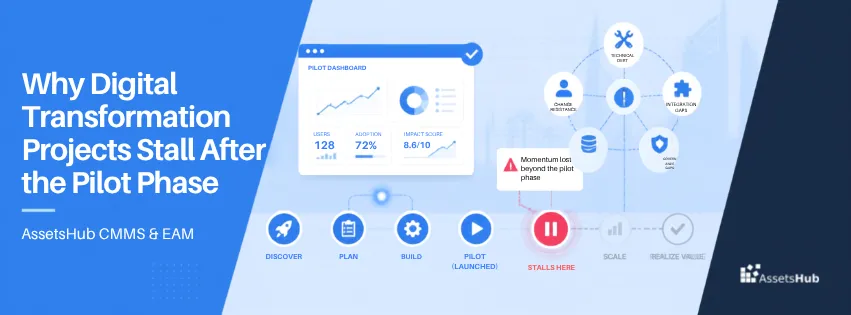
The gap this creates has a name worth being precise about: the pilot-to-scale gap. A digital transformation pilot is a scoped, time-boxed deployment of a new system or process to a limited group, one site, one team, one workflow, run specifically to validate feasibility before a full rollout. The pilot-to-scale gap is the point at which a pilot that met its own success criteria fails to expand into the rest of the organization, because the conditions that made the pilot manageable don't automatically hold at full scale.
This is distinct from a failed pilot. A failed pilot didn't work as intended. A stalled pilot worked exactly as intended and still didn't go anywhere.
Four Structural Causes
Four structural factors explain most pilot-to-scale gaps:
Scope containment vs. scale complexity. A single site or team is small enough that data inconsistencies, integration gaps, and edge cases can be worked around manually. At ten sites, the same gaps become the rollout's blocking issues, because there's no longer a person available to manually patch over them everywhere.
Champion dependency. Most successful pilots have one person, a maintenance manager, a lead technician, who personally drives adoption: chasing incomplete work orders, retraining reluctant staff, catching data-entry errors before they become a pattern. That effort is real, but it's not a repeatable process. It doesn't scale linearly with site count.
Change management debt. The pilot phase absorbs the friction of new habits without needing to justify itself to a skeptical, uninvolved wider organization. Rollout has to overcome that skepticism cold, without the built-in goodwill the pilot team had.
Budget and mandate ambiguity. Pilots are frequently approved to test, not to roll out. Expansion often requires a second, separate approval cycle, one that competes with whatever else is asking for budget by the time the pilot results are in.
How a Stall Actually Unfolds
The pattern that produces a stalled pilot tends to follow the same sequence:
A pilot is scoped and launched at a single site or team, usually with an engaged sponsor driving it.
Early results are measured and reported, typically favorable, since the pilot's conditions (small scope, close oversight, motivated participants) are inherently easier than full-scale operations.
Expansion is proposed, and because it wasn't pre-approved alongside the pilot, it requires new budget or leadership sign-off.
That approval stalls, often because the pilot's success metrics weren't defined in a way that generalizes, closure rates or adoption numbers from one motivated site don't automatically make the business case for the other nine.
Organizational attention moves on to the next priority while the approval sits unresolved.
The pilot remains the permanent state, sometimes for years, rather than a phase the organization passed through.
What the Pattern Actually Tells You
A stalled pilot isn't evidence that the technology didn't work, it's evidence that scaling wasn't designed into the pilot from the start. This distinction matters because it changes what leadership should actually measure. A pilot report showing improved response times and high technician satisfaction says the tool works under pilot conditions. It says very little about whether it will work once the champion who drove adoption is stretched across ten sites instead of one.
The more useful signal to look for during a pilot isn't whether it succeeded, but how it succeeded. If success required constant manual intervention from one motivated person, that's a warning sign dressed up as good news. If success came from the workflow and system design holding up with minimal intervention, that's a genuine predictor of scalability.
Business Impact
The cost of a stalled pilot compounds across several dimensions:
Financial. Licensing and implementation costs are sunk for a tool serving a fraction of its intended footprint, while the rest of the organization continues absorbing the ongoing cost of manual, paper-based processes in parallel.
Operational. Technicians and managers at the pilot site operate differently from everyone else, which complicates cross-site coordination, reporting consistency, and staff transfers between locations.
Reliability. Preventive maintenance visibility and asset history exist for one site and not the rest, which undermines the organization-wide reliability gains the initiative was meant to produce in the first place.
Compliance. Audit readiness becomes inconsistent, one site with a clean, timestamped digital trail, the rest still dependent on paper records with the usual gaps and legibility issues.
Safety. In asset-heavy operations, incomplete inspection and maintenance history across sites means safety-critical records aren't tracked uniformly across the organization, exactly the kind of gap that surfaces at the worst possible time, during an incident review.
A Representative Example
The following is an illustrative, representative scenario, not a specific customer case.
A multi-site facilities management company piloted a digital work order system at its largest location after years of running maintenance entirely on paper and phone calls. The pilot succeeded on its own terms: work order closure times improved, and the site manager, who personally trained every technician and reviewed every entry for the first two months, reported high adoption.
Proposed expansion to the other locations stalled for over a year. No one had defined what "ready to scale" meant beyond the pilot site's own results, and the budget approved covered the pilot only, not a rollout. When the company revisited the initiative, it redesigned the approach around three changes: defining success metrics that didn't depend on the site manager's personal involvement, securing phased rollout budget as part of the original approval rather than as a second ask, and standardizing the site configuration from the outset so each new location could be onboarded using the same setup rather than rebuilt from scratch.
The result was a phased rollout across the remaining locations over the following two quarters, without needing a repeat of the original manual, champion-driven adoption effort at each site.
Common Challenges and How to Overcome Them
Champion dependency. Document the specific actions the champion took, not just "they drove adoption," but the exact interventions: which reports they checked daily, how they corrected data entry errors, how they handled resistant technicians. Turn that into a repeatable onboarding playbook rather than relying on finding another equally motivated person at each new site.
Undefined scale criteria. Before the pilot launches, define what threshold of adoption, data quality, and closure-rate performance would justify expansion, in writing, agreed by whoever holds the rollout budget. Retrofitting these criteria after the pilot is already underway invites debate exactly when momentum is hardest to sustain.
Budget and mandate gaps. Where possible, secure phased rollout budget as part of the original pilot approval, structured as a stage-gate rather than a fresh proposal. A rollout that depends on convincing the same stakeholders twice is competing with next quarter's priorities on top of its own merits.
Pilot-specific architecture. Configurations, integrations, or manual workarounds built to make the pilot work quickly often don't generalize. Design the pilot's data structure and site configuration the way you'd want it at full scale from day one, even if only one site is live initially.
Fading executive sponsorship. Pilot launches get attention; the six-month gap before rollout approval often doesn't. Build a specific, calendared check-in for the rollout decision into the original project plan, rather than leaving it to whenever someone remembers to revisit it.
Where the Pilot's Own Architecture Matters
Some of this risk is structural to how the pilot itself is built. A platform designed around single-location deployment, then stretched to cover multiple sites later, tends to reproduce the scope-containment and configuration problems described above, the pilot's setup becomes the thing that needs to be redone at scale, not just extended.
AssetsHub is built around multi-site asset and work order management from the ground up, which changes what a pilot actually looks like in practice. A pilot site's location hierarchy, asset categories, and work order structure are configured the same way they would be for the full rollout, so scaling to additional sites is a matter of onboarding, not redesign. Reporting is structured at the multi-site level from day one, which means the metrics used to justify expansion are already comparable across sites rather than needing to be reconstructed after the fact.
What a Scale-Ready Pilot Looks Like in Practice
A pilot structured to scale, rather than to simply prove feasibility, typically follows a sequence like this inside AssetsHub:
Configure the full intended location hierarchy, all planned sites, not just the pilot site, along with standardized asset categories and work order templates, before onboarding a single technician.
Launch the pilot at one site using that same configuration, rather than a simplified or ad hoc setup unique to the pilot.
Track adoption and performance metrics, work order closure time, PM compliance rate, technician login frequency, at the site level within the platform's built-in reporting, so results are comparable to whatever threshold was defined before launch.
Use those baseline numbers against the pre-agreed stage-gate criteria to make the expansion decision, rather than a general impression of how the pilot "felt."
Onboard the next sites in batches, reusing the same configuration, training materials, and workflows validated in the pilot rather than rebuilding them per site.
FAQ
How long should a maintenance digitization pilot run before deciding on rollout?
Most pilots need 60 to 90 days of live operation to generate meaningful signal, enough time to capture at least one full preventive maintenance cycle and enough completed work orders to compare against the paper-based baseline. Running much longer without a rollout decision doesn't add confidence; it usually signals that success criteria weren't defined clearly enough at the start.
What's the biggest predictor that a pilot will scale successfully?
Whether the pilot's success depended on one engaged champion or on the process itself. If technician adoption and data quality held up because a manager personally chased people down, that effort won't transfer to five more sites at once. Pilots that succeed through documented workflows and system design, not personal persistence, scale far more predictably.
Should every site pilot be treated the same, or does scope matter?
Scope matters. A pilot covering one narrow workflow, like preventive maintenance scheduling, validates something different than a pilot covering a full site's work order lifecycle. Match the pilot's scope to what you actually need to prove before committing budget, a narrower pilot answers questions faster, but a broader one surfaces integration issues sooner.
What if the pilot succeeded but leadership loses interest before rollout?
This is common when rollout wasn't budgeted alongside the pilot itself, only the pilot was. Treat pilot approval and phased rollout approval as one decision made at the same time, with rollout budget contingent on pilot results rather than requiring a fresh approval cycle. Otherwise, the pilot's success has no natural path forward once initial attention moves elsewhere.
Is it better to pilot narrow (one workflow) or broad (one full site)?
Neither is universally better; they answer different questions. A narrow pilot proves a specific workflow works, useful when the risk is mainly technical. A broad, single-site pilot proves the organization can run digitally end to end, useful when the risk is mainly adoption and change management. Pick based on which risk concerns you more.
Conclusion
Pilots stall after success more often than they fail outright, and the two get treated too similarly. A stalled pilot usually means the pilot proved the tool works under pilot conditions, small scope, close oversight, a motivated champion, without ever testing whether it works without those conditions.
The practical takeaway is to treat the pilot's design as the first test of scalability, not just of the tool. Define what "ready to expand" means before the pilot launches, secure rollout budget alongside pilot budget rather than after, and build the pilot's technical configuration the way you'd want it at full scale from the start. A pilot designed this way either scales cleanly or fails fast enough to redirect the investment, both are better outcomes than eighteen months in an unresolved holding pattern.