Tracking all three in spreadsheets and chat groups leaves gaps that stay invisible until an inspection or a breakdown exposes them.
Three come from Saudi regulation. The fourth comes from how crews actually work on site.
The General Directorate of Civil Defense runs licensing through its Salama platform, and the application typically includes a maintenance contract for safety equipment. Regulators go further for the entities they supervise: SAMA, for example, asks financial institutions to keep a safety register recording monthly inspections, periodic tests and maintenance of fire-fighting equipment, in line with the Saudi Building Code (SBC 801).
Under the Saudi Labor Law, working hours for Muslim employees drop to six a day and 36 a week during Ramadan. Because the month moves about eleven days earlier each year in the Gregorian calendar, technician capacity and preventive routes have to be re-planned every year, not once.
The Personal Data Protection Law has been fully enforceable since September 2024, and SDAIA's regulation governs transferring personal data outside the Kingdom. The National Cybersecurity Authority's cloud controls add to that. Procurement teams in the Kingdom therefore tend to ask software suppliers how data is hosted, accessed and transferred.
Supervisors, technicians and contractors on the same site often work in different languages. Work order instructions, asset names and fault descriptions have to be readable by everyone who touches the job.
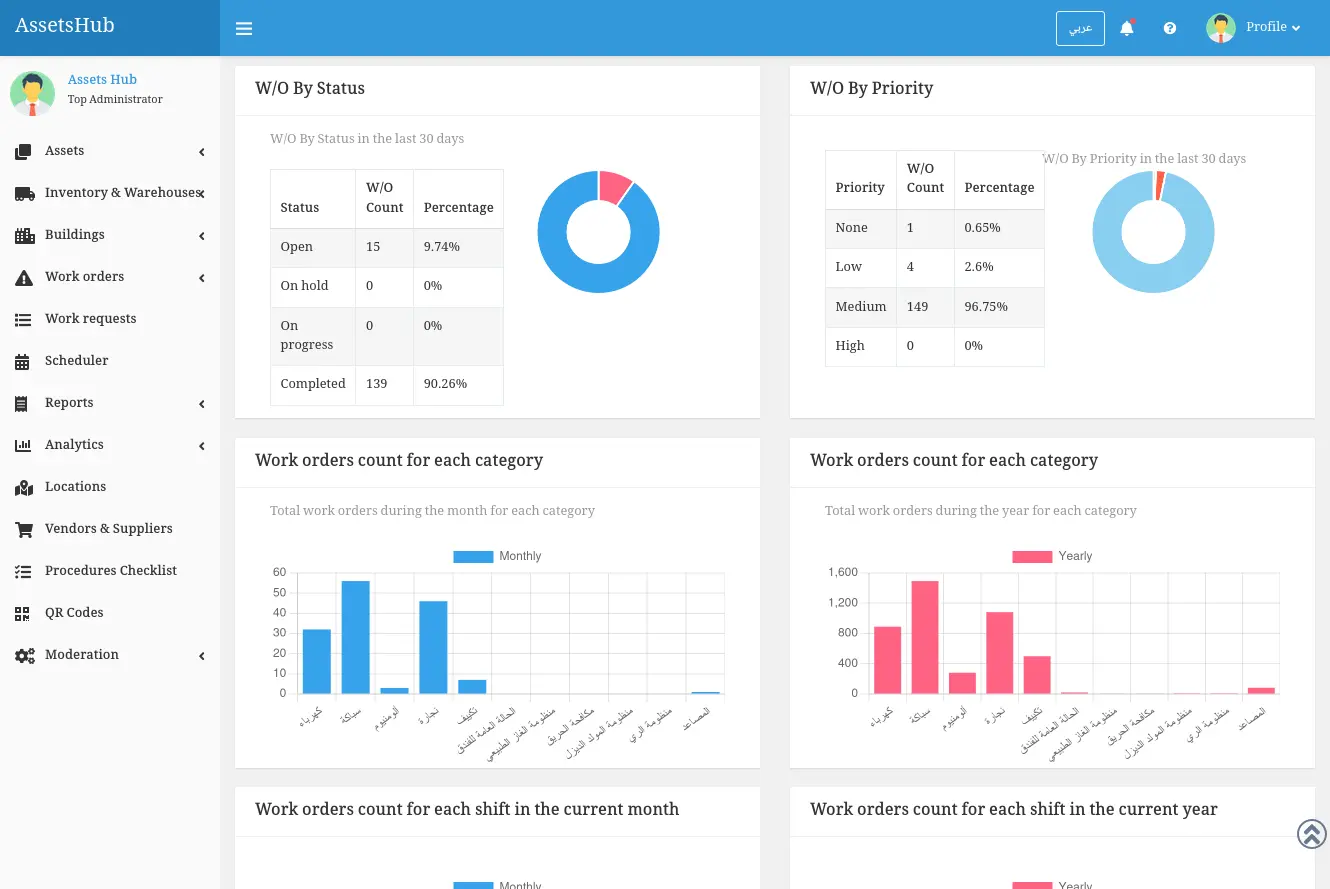
AssetsHub was introduced as the first smart Arabic cloud app for tracking assets and managing maintenance plans and tasks. It is developed and supported by one team, AssetsHub L.L.C.
Design and development stay with one team in the MENA region, with no reseller or third-party platform between a customer's request and the engineers who can act on it.
The interface and the public site are available in Arabic and English, so each person on the team can work in the language they are comfortable with.
Training and technical support are provided directly by the team that develops the product, in Arabic and English.
The same work order, asset, inventory and preventive maintenance modules serve facilities, fuel stations, factories, hospitals and more, so a group with several lines of business keeps one record.
| Reality | What AssetsHub provides |
|---|---|
| Fire-safety and inspection records | Preventive maintenance schedules per asset and site; work orders with notes and photos; custom reports of inspection and maintenance history. |
| Ramadan and seasonal re-planning | Editable preventive schedules, priorities and deadlines on work orders, and a multi-location view of the workload at each site. |
| Procurement and data questions | Security and hosting details are available on request for your procurement review. |
| Mixed-language crews | Arabic and English interface, mobile apps for iOS and Android, and QR code and barcode scanning to identify an asset without typing. |
These are the industries AssetsHub supports in the Kingdom. The industries page lists the rest.
SLA-tracked requests and recurring preventive routes per client site.
Tenant requests, unit turnover checks and cost history per building.
HVAC, escalators and refrigeration across branches or one large complex.
Preventive maintenance and calibration schedules, with service history per device.
Room-level fault reports and planned seasonal maintenance.
Departmental requests, contractor tracking and periodic inspections.
Scheduled inspections per station and fault tickets routed to field technicians.
Work orders for planned shutdowns, inspection rounds and critical spares.
Planned maintenance scheduled around the academic calendar.
Preventive maintenance by calendar or running hours, with breakdown records.
The maintenance manager reviews preventive routes per branch and moves heavy work, such as HVAC servicing and fire-system tests, ahead of the shorter Ramadan hours.
Work orders reach technicians in the mobile app. Each technician scans the asset's QR code, completes the task and attaches notes and photos.
Monthly inspections and periodic tests recur per branch and per asset, so the inspection record builds up from completed work orders instead of a spreadsheet filled in afterwards.
When an inspection or audit is announced, the manager pulls a report of inspection and maintenance history per site and shares it with the accredited safety contractor or consultant.
This is an illustrative scenario, not a customer case.
Fuel station operators in Saudi Arabia use AssetsHub for inspection schedules and multi-station monitoring. Their feedback is published on the fuel stations page.
Here are some of the basic types of questions for our customers
Free 14-day trial
No credit card needed